12-Week Intensive Program
The full curriculum,
laid out plainly.
Six modules. One factory floor. A cohort of 15 engineers who finish knowing what they're doing.
Six modules. One factory floor. A cohort of 15 engineers who finish knowing what they're doing.
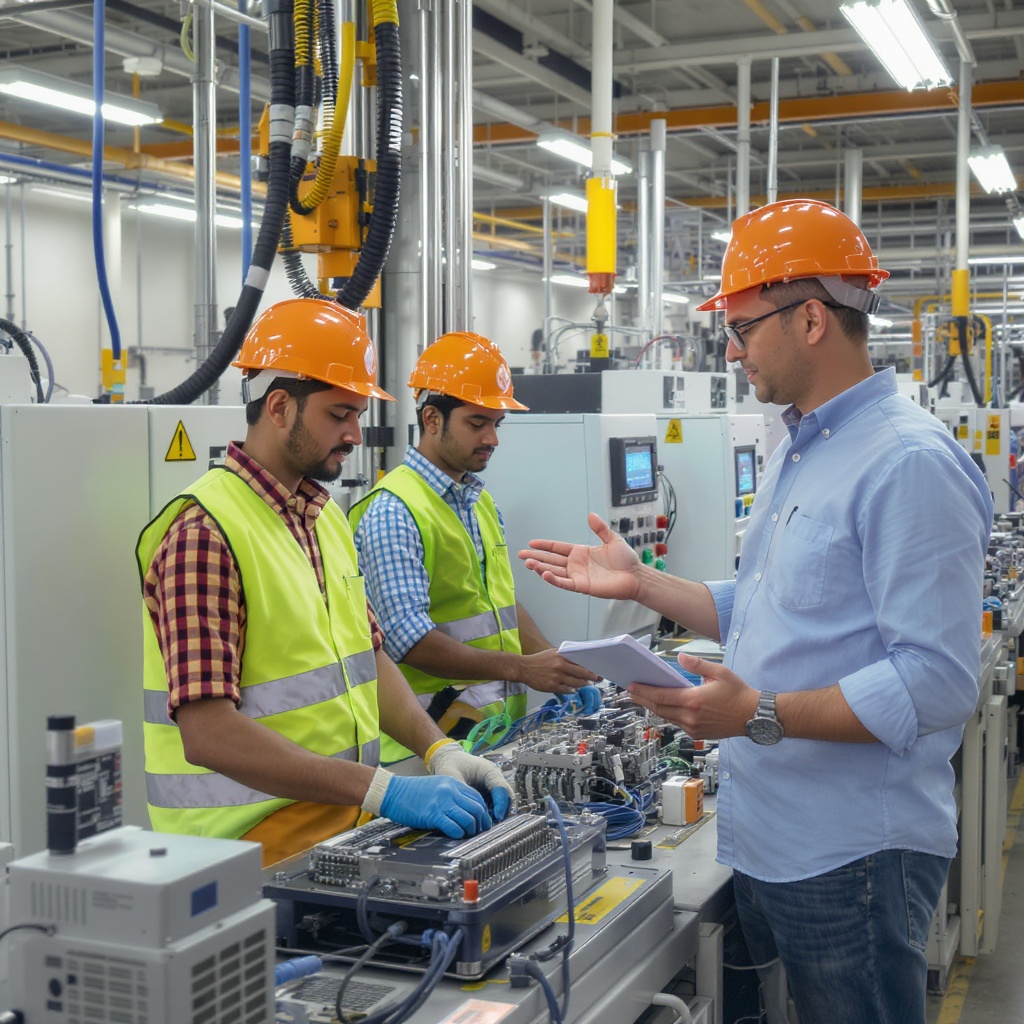
Each module builds on the last. You don't just learn theory — you apply it on the factory floor as you go.
Start here. Relay logic, ladder diagrams, wiring standards, motor control circuits — the language that everything else is written in. You wire actual control cabinets from scratch, not simulation software.
Ladder logic, function blocks, sequencers, and structured text on real S7-1200 and S7-1500 hardware. You program machines that are running on the production floor — not a virtual PLC in a training room.
Cross-platform proficiency. You need to be comfortable with both major PLC families — most factories run a mix. Structured text, PID loops, and real-world debugging on live Logix hardware.
Building operator interfaces from scratch — alarm screens, trend displays, manual override panels, operator prompts. Everything connects to live PLC tags on the factory floor, not a mock database.
Multi-station supervisory systems. Historian configuration, tag management, data logging, remote access, and trend analysis. You're building the interface plant managers use to run operations.
How machines actually talk to each other. PROFINET and Ethernet/IP configuration from scratch — device assignment, I/O mapping, diagnostic monitoring. Modbus TCP for integrating legacy equipment. Industrial Ethernet architecture and troubleshooting.
FANUC robot programming — motion paths, tooling offsets, program structure. Working with actual robotic welding and assembly stations in the facility. End-of-arm tooling setup and collision avoidance.
Putting it all together. Multi-station automated cells, part-handling sequences, vision-guided inspection, and conveyor control. Integration testing on real production sequences — not textbook scenarios.
The skill that separates a junior engineer from a useful one. Systematic fault isolation, commissioning checklists, start-up procedures, working under real production pressure. You're in the hot seat — the line is down and you need to get it running.
Relay logic, ladder diagrams, wiring standards, motor control circuits. The foundation everything else rests on.
Ladder logic, function blocks, sequencers, PID loops. Programming on real PLC hardware — not simulators. Projects tied to factory floor machines.
Building operator interfaces from scratch. Configuring screens, alarms, trend displays, and data logging. Connecting to live PLC data on the production floor.
PROFINET, Ethernet/IP, Modbus, industrial Ethernet architecture. How machines actually communicate in a modern manufacturing plant.
Robot programming, end-of-arm tooling, automated inspection systems. Working with actual robotic welding and assembly stations in the facility.
The skill that separates a junior engineer from a useful one. Diagnostic techniques, fault isolation, start-up checklists, working with real production pressure.

Hear from engineers who trained at SkillForge

"I had theoretical knowledge of PLCs from college. SkillForge gave me the practical exposure that made employers take me seriously. I modified a live S7-1200 program on my second week."
"What stood out was working on real machines, not simulators. I was diagnosing HMI faults on a live production line by week 7. That's what made the difference in my interview."
"The industrial networking module was the most valuable. I configured a PROFINET network in our factory after the program — something I had no idea how to do before SkillForge."
"I joined with a mechanical engineering background. After 12 weeks I was reading ladder logic and working with RSLogix 5000. The factory floor exposure changed how I think about automation."
"The troubleshooting week was the realest interview prep I could have asked for. I walked into my interview and described actual fault scenarios I had worked through on the floor. They hired me on the spot."
"Small batch size meant actual attention from instructors. By week 10 I was programming a FANUC robot cell alongside my peers. That project became the centerpiece of my portfolio."
We keep batches small because the factory floor doesn't accommodate 40 people at once. If you're serious about working in automation — apply now. Early applications get a curriculum deep-dive call before the cohort fills.